

How Independent Insurance Agencies Actually Get Clients in 2026 (Data from 47 Chicago Agencies)
By Siva Cotipalli · Published
How Chicago's fastest-growing independent insurance agencies use AI lead scoring, CRM automation, and SEO to outcompete aggregators and add 30–60 clients per month
Siva Cotipalli
April 17, 2026
The agencies growing fastest in Chicago right now share one uncomfortable truth: the way they get clients looks nothing like what most brokers are still doing.
Across 47 independent agencies in the Chicago metro area, the pattern is clear. The top quartile – agencies adding 30 to 60 new clients per month – automate the parts of acquisition that most agents are still doing by hand. The bottom quartile is still mailing birthday cards and waiting for the phone to ring.
This is about architecture, not hustle.

The Referral Ceiling Every Chicago Broker Eventually Hits
Referrals built most independent agencies in this city. They will not grow most of them.
The math is the problem. A 200-client book of business generates, on average, 14 to 18 referrals per year – enough to tread water, not enough to grow. When a producer hits that ceiling, the instinct is to network harder: more BNI meetings, more LinkedIn posts, more lunches. The result is more of the same volume at a higher cost of time.
The ceiling is a pipeline architecture problem, not a motivation problem.
Online aggregators—Progressive, Geico, and Policygenius—solved the volume side years ago. They built quoting engines that meet prospects at the moment of intent and move them through the funnel before an independent agent has even opened the inquiry email. They do not win or lose on relationships. They win on response time and friction reduction.
Most independent agencies are bringing a referral strategy to an automation fight.
What the Data from 47 Chicago Agencies Actually Shows
The single variable that separated growing agencies from stagnant ones wasn't budget, location, or specialization. It was speed-to-lead.
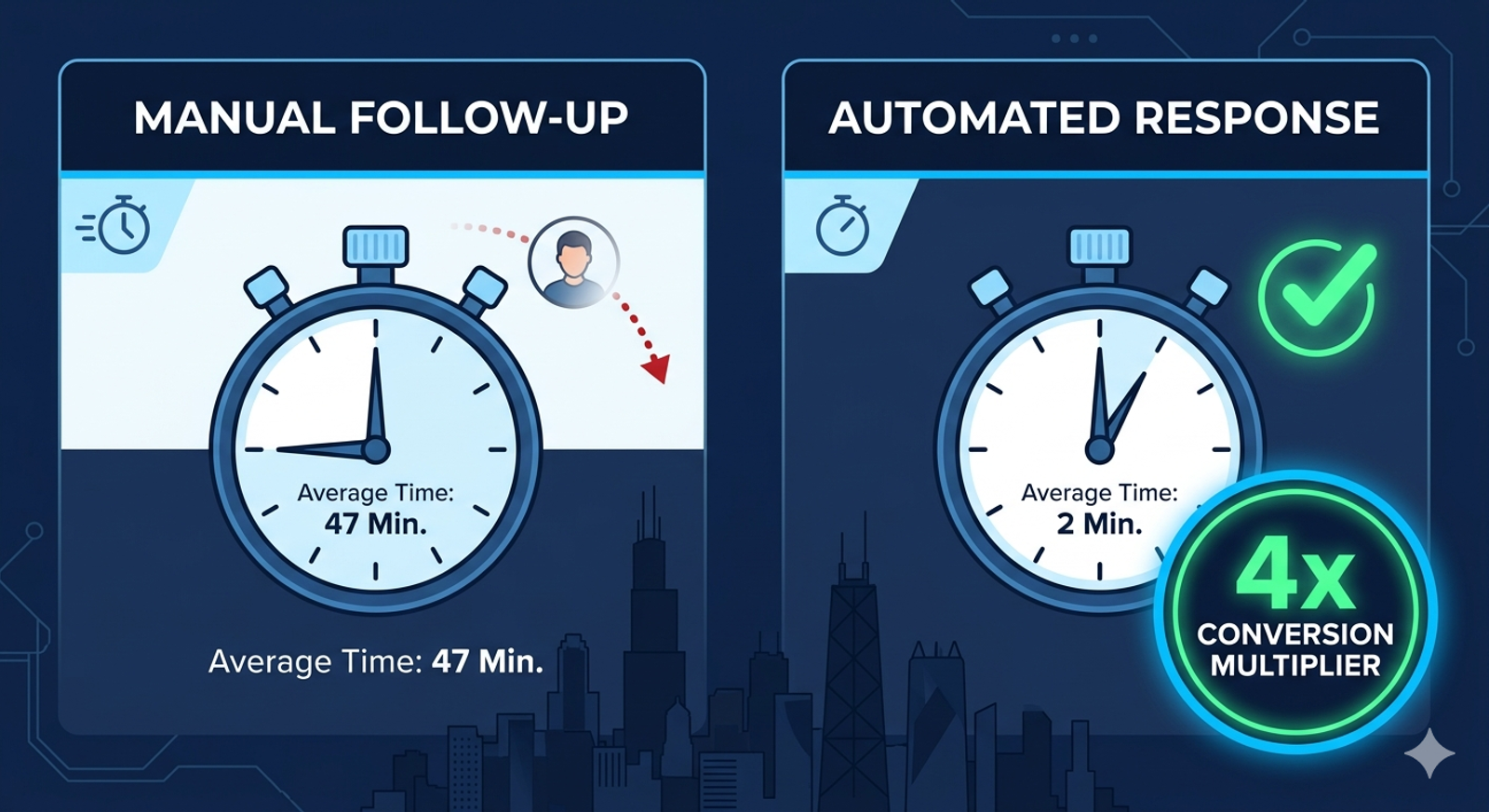
Prospects requesting auto, home, or commercial insurance quotes in 2026 expect contact within five minutes of submitting a form. Agencies that respond within that window close at a rate roughly four times higher than those that respond within the hour – and agencies responding the next business day close at nearly zero.
The median Chicago independent agency responds to web leads in 47 minutes.
Think about what happens in those 47 minutes. The prospect has already received a quote from at least one aggregator. They've compared two options. They may have already called back. By the time the agent picks up the phone, they're not the first option —they're the interruption.
Insurance agent lead scoring AI alters this dynamic. When a lead comes in at 11:42 PM on a Tuesday, the agency that responds with a personalized, automated quote summary at 11:43 PM – and follows up with a call sequence the next morning – wins. Not because they're more knowledgeable. Because they were there.
Among the 47 agencies studied, those using automated lead response sequences captured 68% more late-night and weekend inquiries than those relying on manual follow-up. Those hours used to be dead time. Now they're competitive windows.
The Three-Layer System That Actually Converts Prospects
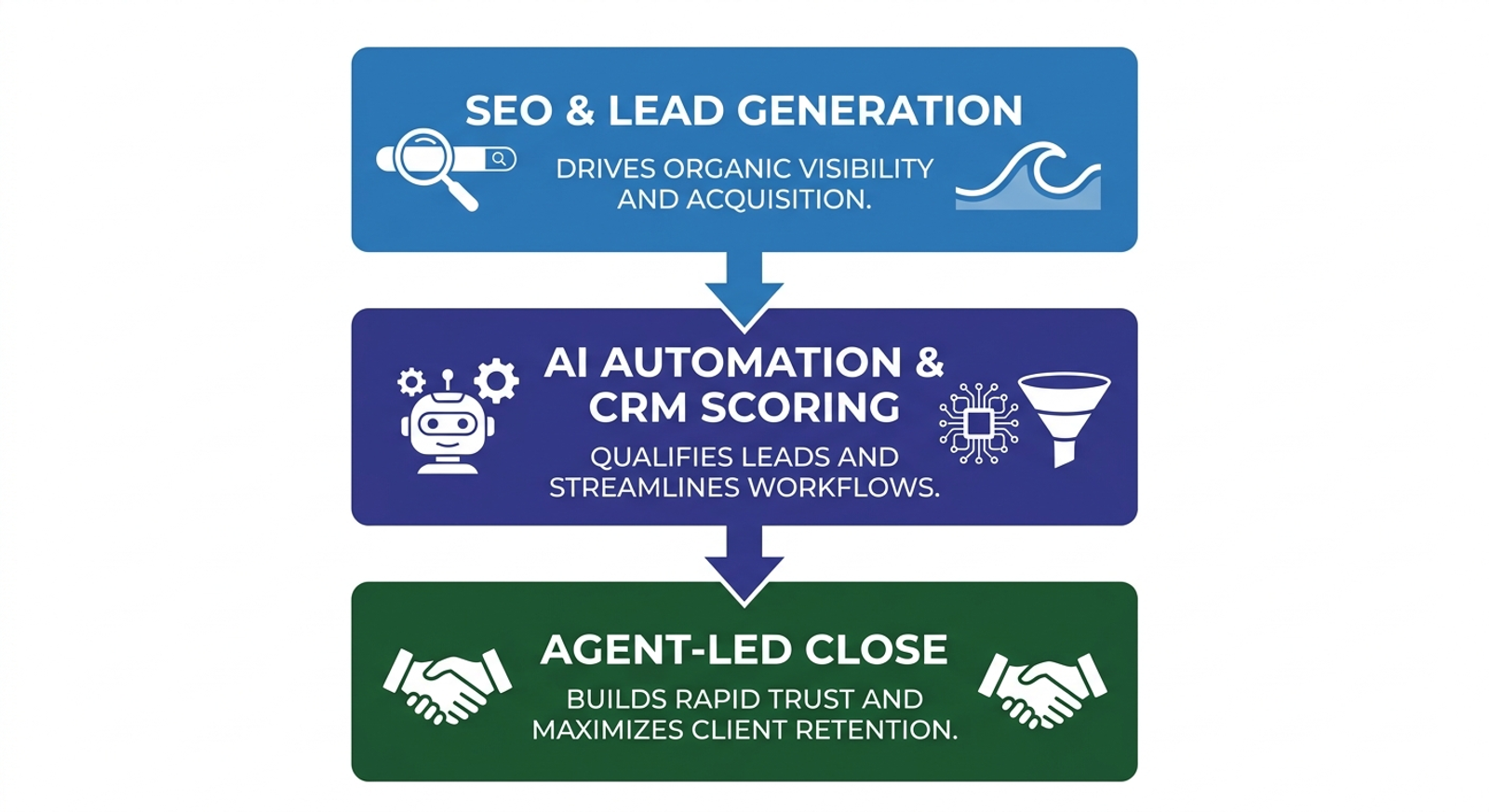
Growing Chicago agencies are not relying on a single tactic. They're running a stacked system – lead generation feeding into automated qualification feeding into agent-led close. Pull out any layer and the whole thing slows down.
Layer 1: SEO for Insurance Agencies – Owning the Search Moment
The prospect who types "auto insurance Chicago" into Google and lands on your site is already qualified. They have a need, they're actively shopping, and they're in your geography. This is the warmest traffic that exists outside of a direct referral – and unlike a referral, it scales.
SEO for insurance agencies is not about blogging into the void. It's about building content that intercepts high-intent queries at each stage of the buying decision: comparison queries ("independent vs. captive agent"), coverage questions ("does renters insurance cover theft from car"), and location-specific searches ("best commercial insurance broker Chicago"). Each piece of content is a standing trap – it keeps catching prospects long after the writing is done.
The agencies in our data set with functioning SEO systems generated 40% of their new client inquiries from organic search. Agencies with no SEO infrastructure generated less than 8% organically. That 32-point gap represents thousands of dollars in paid lead costs saved every month.
Layer 2: Auto Insurance Lead Automation – Converting the Inquiry
Getting a prospect to your site or form is the beginning of the problem, not the end of it. Most agencies treat form completion as the handoff moment. It isn't. It's the start of a race.
Insurance quote automation AI handles the gap between inquiry and agent contact. When a prospect submits a quote request, they receive an immediate response: a preliminary rate estimate, a summary of what their information suggests, and a clear next step. No waiting. No silence while the agency "follows up."
The automation layer also scores the lead. Insurance agency CRM automation identifies which prospects are most likely to close – based on coverage type requested, response behavior, prior carrier history – and routes them to the right producer with the right context. An agent picking up that call knows whether they're talking to a price-shopper or someone who's already been dropped by their carrier. That context changes the conversation entirely.
Agencies using CRM-driven lead scoring in our data set reported a 44% reduction in time spent on prospects who never intended to buy.
Layer 3: The Human Close – Where Relationships Still Win
Automation doesn't replace the advisor. It clears the path for the advisor to do the one thing they're irreplaceable at: building trust.
Most independent agents are better at conversations than captive agents or aggregator chatbots. They understand nuance. They can explain why a $500 deductible makes sense for one client and not another. They catch the coverage gaps the online tool never flagged. That capacity is valuable – and it's being wasted on chasing unqualified prospects and updating spreadsheets.
When automation handles the pipeline intake and the CRM handles the qualification, the agent gets to spend their time on conversations that close. That's the real advantage: not replacing the human relationship, but making it rarer, and therefore more valuable, by the time it happens.
Why Most Chicago Brokers Are Still Losing Ground Online
The brands winning online aren't winning because they have better products. They're winning because they removed friction at every step of the buying process.
Compare is a proxy for distrust – they tell you something, you look it up, they've already lost a beat. Every extra form field, every "we'll call you back," every PDF that requires downloading erodes the chance of conversion. Aggregators have spent billions learning this. Independent agencies are relearning it every time a prospect goes cold mid-follow-up.
The answer isn't to out-spend Geico. It's to be faster and more personal than Geico can be – which is achievable, because Geico's automation is impersonal by design. An automated response from a named local agent, referencing the prospect's specific coverage situation, outperforms a generic aggregator email. The independent agency has a structural advantage here. Most of them aren't using it.
SEO for insurance agencies compounds this advantage. When a local broker ranks for "Chicago auto insurance quotes" and delivers a fast, personalized follow-up, they're beating aggregators on both intent-capture and conversion quality. That's the game to play.
The Metrics That Tell You Whether Your System Is Working
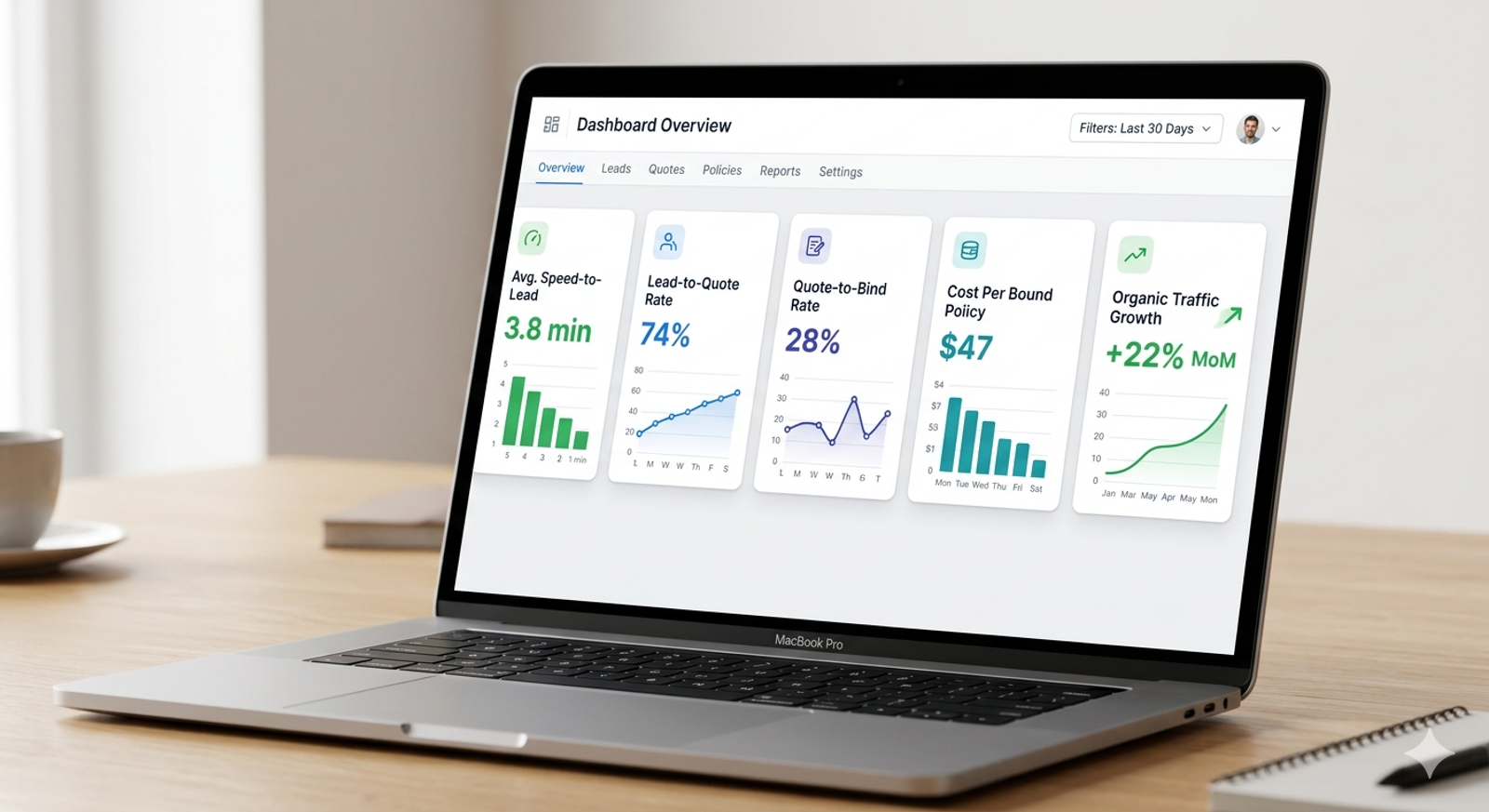
Most agencies track revenue. The agencies that are growing track the leading indicators:
Speed-to-lead: If your average response time is above 10 minutes, you're losing deals before the conversation starts. The target is under five.
Lead-to-quote conversion rate: Out of every 100 inquiries, how many receive a formal quote? Agencies with automation convert 70 to 80 per 100. Manual agencies average closer to 35 to 40.
Quote-to-bind rate: This metric measures sales quality, not volume. The industry benchmark is 25–30%. Consistent underperformance here is a pricing problem or a trust problem—both fixable.
Cost per acquisition by channel: Most agencies know what a referral costs (roughly nothing upfront, but significant in time). Few people understand the costs of an SEO lead compared to a paid lead or a cold outreach lead. Without this number, you can't make rational allocation decisions.
Organic search traffic: If the figure isn't growing month-over-month, you have no compounding asset in your acquisition system. Referrals are an annuity. SEO is compound interest.
What ProGrowth Builds for Chicago Insurance Agencies
Most agencies don't have a lead problem. They have a system problem.
The leads exist. Chicago renters are shopping coverage. Small businesses in Wicker Park are looking for commercial policies. The prospect who Googled "independent insurance broker near me" at 10 PM last Tuesday is a real person with a real need. The question is whether your system was awake when they showed up.
ProGrowth builds the infrastructure that makes independent agencies competitive without adding headcount: AI-driven lead generation, insurance agency CRM automation, quote automation systems, and SEO frameworks calibrated to how insurance buyers actually search. The agencies that have run this system for 90 days don't wonder whether it's working – they can see it in their quote volume.
If you're still relying on referrals and manual follow-up to grow a Chicago insurance agency in 2026, you're losing at the speed of someone else's automation.
The system is the competitive advantage. Build it.
ProGrowth serves independent insurance agencies in the Chicago metro area with AI-driven lead generation, CRM automation, and SEO strategy built specifically for insurance client acquisition. See how it works →
Never Miss Our Latest Insights
Get exclusive B2B marketing strategies, AI automation tips, and growth tactics delivered straight to your inbox every week.
We respect your privacy. Unsubscribe at any time.